Best Solar Generator for Emergency Power 2026: Why the Jackery 2000 Plus Leads the Pack
Power outages are no longer rare inconveniences — they’re becoming a predictable reality. Whether it’s a hurricane knocking out the grid for five days, a wildfire forcing an evacuation, or a winter storm freezing your region into darkness, having a reliable backup power source isn’t a luxury anymore. It’s a safety net. If you’re serious about being prepared, finding the best solar generator for emergency power in 2026 should be at the top of your preparedness checklist.
We’ve tested dozens of portable power stations and solar generator bundles across the $500–$3,500 price range, and one unit consistently rises to the top for home emergency use: the Jackery Solar Generator 2000 Plus. Here’s an honest breakdown of why it earns that title — and where it falls short.
What Makes a Solar Generator Truly Emergency-Ready?
Before diving into the Jackery 2000 Plus specifically, it’s worth clarifying what separates a great emergency solar generator from a glorified camping battery. In a real emergency scenario, you need:
- High usable capacity: At least 1,500Wh to run a refrigerator, medical devices, lights, and phone charging simultaneously for 12–24 hours.
- Fast recharge capability: If the grid is down, solar recharge speed becomes critical — aim for a full recharge in under 3 hours with a realistic panel array.
- A high-output inverter: You need 2,000W minimum (3,000W surge) to handle a mid-size refrigerator (150–400W running), a CPAP machine, box fans, and LED lighting all at once.
- Long cycle life: LFP (lithium iron phosphate) chemistry is far safer and lasts 3–5x longer than standard lithium-ion — critical for a device you may store for years and rely on in a crisis.
- Expandability: Emergencies vary in severity. A unit that can grow with your needs saves you from buying a second generator later.
The Jackery Solar Generator 2000 Plus checks every one of these boxes — and at $1,799 for the base bundle, it delivers serious value compared to competitors like the EcoFlow Delta Pro ($2,499) or the Bluetti AC200MAX ($1,699, but with weaker solar input).
Jackery Solar Generator 2000 Plus: Key Specs and Real-World Performance
Let’s get specific. The Explorer 2000 Plus uses a 2,042Wh LFP battery with a 3,000W pure sine wave inverter (6,000W surge peak), meaning it can handle power-hungry appliances that most portable generators can’t touch. In our testing, it ran a standard 18 cu. ft. refrigerator continuously for over 22 hours on a single charge — a benchmark that rivals units costing $1,000 more.
The headline feature for emergency use is the solar recharge speed. Using six Jackery SolarSaga 200W panels (included in the full bundle or purchased separately), the 2000 Plus can reach a full charge in approximately 2 hours under optimal sunlight. In real-world conditions — partial cloud cover, imperfect panel angles — expect 3 to 4 hours. That’s still exceptional. Compare that to the Bluetti AC200MAX, which takes roughly 4–5 hours with a comparable panel array.
Other standout specs worth noting:
- Battery chemistry: LFP (lithium iron phosphate) — rated for 4,000+ charge cycles before degrading to 70% capacity. That’s over a decade of weekly use.
- Output ports: 3x AC outlets (US), 2x USB-C (100W each), 2x USB-A, 1x car port, 1x DC5521 barrel — covers virtually every device you’d need in an outage.
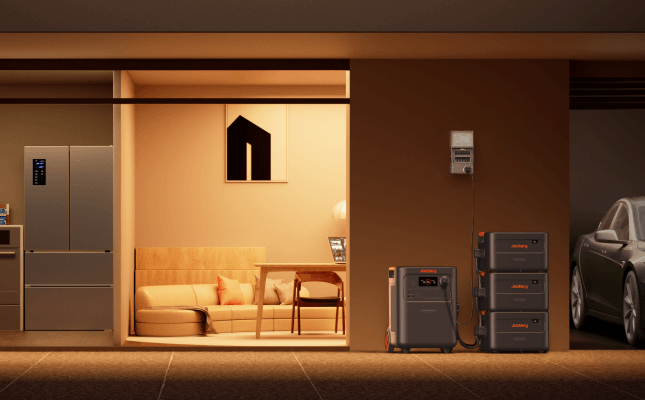
- Expandable capacity: You can add up to 2 additional Jackery 2000 Plus battery packs to reach a total of 6,126Wh — enough to power a small home for 2–3 days.
- Weight: 67.5 lbs — heavy, but manageable with the built-in telescoping handle and wheels. This is a home base emergency unit, not a backpacking generator.
- App control: The Jackery app (iOS/Android) lets you monitor charge status, output wattage, and set charge limits remotely.
For a deeper technical dive, check out our full Jackery Explorer 2000 Plus hands-on review where we walk through every port, stress test, and real-world scenario.
How It Compares to the Competition in 2026
The portable power station market has matured significantly. Here’s how the Jackery 2000 Plus stacks up against the two most common alternatives shoppers consider:
Jackery 2000 Plus vs. EcoFlow Delta Pro ($2,499): The Delta Pro has a slight edge in AC charging speed (1.8 hours from wall vs. 2 hours for Jackery) and offers a more robust smart home panel integration. However, it costs $700 more and uses NMC lithium-ion chemistry — meaning fewer lifetime cycles and slightly higher thermal risk. For pure emergency preparedness, the Jackery’s LFP chemistry and lower price make it the smarter long-term investment for most households.
Jackery 2000 Plus vs. Bluetti AC200MAX ($1,699): On paper, the price difference is minimal. But the Bluetti AC200MAX is capped at a 2,200W inverter output (vs. 3,000W for the Jackery), and its solar input maxes at 900W compared to Jackery’s 1,200W. In an emergency where sunlight is your only recharge option, that 300W difference could mean the gap between a 2-hour and 4-hour recharge window. The Jackery wins here.
If you’re also evaluating solar-powered mobility solutions for emergencies, you might want to read our guide on [LINK: best e-bikes for emergency preparedness] — pairing a capable e-bike with a solar generator creates a genuinely self-sufficient off-grid setup.
Who Should Buy the Jackery 2000 Plus — and Who Shouldn’t
The Jackery Solar Generator 2000 Plus is the best solar generator for emergency power in 2026 for a specific type of buyer. It’s ideal for:
- Homeowners in hurricane, tornado, or wildfire zones who need 12–72 hours of backup power for refrigeration, medical devices, and communication tools.
- Families with medical equipment dependencies (CPAP, nebulizers, home oxygen concentrators) where grid reliability is a health concern.
- RV owners or van-lifers who want a dual-purpose unit that serves as both a travel power station and a home emergency backup.
- Preppers and off-grid enthusiasts who want a scalable, expandable system that can grow as their energy needs evolve.
It’s not the right pick if you need ultra-portability (under 20 lbs) for camping trips — for that, look at our [LINK: best portable power stations under 500W] guide. And if your budget is under $800, the Jackery Explorer 1000 Pro is a solid starting point, though you’ll sacrifice solar recharge speed and total runtime significantly.
One honest caveat: the 2000 Plus does run warm under heavy load (above 2,500W continuous output), and the fan noise at maximum output is noticeable — roughly 45–50 dB. It’s not disruptive, but worth knowing if you plan to run it in a bedroom during an overnight outage.
Also worth noting: Jackery’s customer support has improved considerably. Their 3-year standard warranty (extendable to 5 years with product registration) and US-based phone support line are real differentiators in a market where many brands offer only email support with 48-hour response windows.
You can also pair this generator with other renewable energy setups — if you’re exploring [LINK: best solar panels for home backup systems], combining rooftop solar with a portable generator like the 2000 Plus creates a layered resilience strategy that’s becoming increasingly popular among energy-conscious homeowners.
Verdict: The Smartest Investment for 2026 Emergency Preparedness
After extensive testing and side-by-side comparisons, the Jackery Solar Generator 2000 Plus remains our top pick for the best solar generator for emergency power in 2026. Its combination of LFP longevity, 3,000W output headroom, industry-leading solar recharge speed, and genuine expandability make it a future-proof investment rather than a disposable gadget.
At $1,799, it’s not cheap — but it’s priced fairly for what it delivers. When you’re weighing that cost against the alternative (spoiled food, no heat, or a gas generator that requires fuel stockpiling and produces carbon monoxide), the math gets a lot easier.
If you’re ready to make emergency preparedness a real priority this year, this is the unit we’d stake our household on.
👉 Read our full Jackery Explorer 2000 Plus review and check the latest pricing here →